
The Creative Act
Dead Horse Point + Canyonlands – January 2022
A Pilgrimage Under the Stars
Authentic photography of real places, real light, and real moments is often a pilgrimage—a search for extraordinary light, compelling subjects, and the decisive moment when everything comes together.
Into the Darkness
I leave Moab at midnight, driving into the darkness toward Dead Horse Point, an hour away. The final twenty miles require four-wheel drive as snow and ice blanket the road. My tires crunch steadily upward, climbing toward six thousand feet.
At the end of the road, I step into a pitch-black night. The silence is striking—almost unsettling.
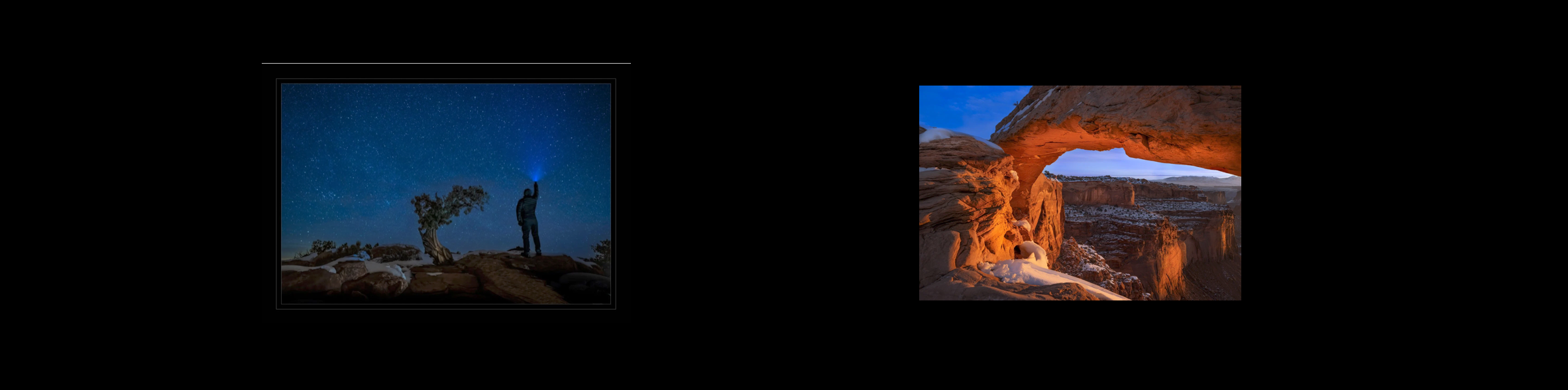
Beneath a canopy of stars, I make my way to the cliff's edge and set up my tripod before an old friend—a 600-year-old pinyon pine.
Coyotes sing from the basin below, while somewhere nearby an owl quietly asks, "Who... who... who are you?"
An Old Friend
We've shared many moments together—this ancient tree and I—during summer thunderstorms, at first light after an overnight snowstorm, and on countless nights beneath a blanket of stars.
She is beautiful.
Her trunk rises in a graceful S-curve from the bare sandstone. As best I can determine, this ancient pinyon pine has stood here for more than six centuries.
She has witnessed two world wars, the dawn of the nuclear age, and the first footsteps on the moon overhead. She has endured blistering desert summers and bitter winter storms, standing steadfast—rooted in stone, resilient, solitary, and timeless—keeping quiet watch over the vast canyon below.
Why I'm Here
Why would anyone stand alone on a frigid January night with nothing more than a camera and tripod?
Because winter moisture washes the desert air clean, removing the dust and haze carried by summer winds. The result is remarkable clarity and extraordinary sharpness. Just as important, Dead Horse Point is an International Dark Sky Park, where the absence of artificial light reveals one of the darkest and most spectacular night skies in the world.
Out here, the heavens come alive.
The Questions
Beneath this celestial ocean, the questions always seem to return.
Why me?
Why am I here?
What is this life all about?
Is anyone out there?
A Quiet Conviction
Standing beneath a sky filled with countless stars, my faith quietly deepens.
Science tells us there are more than two trillion galaxies. Yet here I stand, on this small planet, beneath one small corner of the universe.
Moments like these leave me with a quiet conviction that life is not an accident, and that we are part of something far greater than ourselves.
The Final Frame
Two hours later, I finish photographing the ancient pinyon beneath the winter sky. Before leaving, I make one final image—a self-portrait.
I set a ten-second delay, step beside the old tree, and stand motionless as the shutter opens... and closes.
My flashlight reaches toward the heavens—still searching, still wondering.
The Creative Act (Continued)
Mesa Arch – Canyonlands National Park
Before Dawn
Four hours later, it is 3 a.m. on that same frozen night.
I leave Dead Horse Point and make my way toward Canyonlands, the spirit of the night slowly yielding to dawn. Sunrise is forecast for 7:42 a.m.—a long wait in the heart of winter.
I hike through a foot of snow, my headlamp cutting a narrow path through the darkness. My body hums with anticipation, though the lack of sleep leaves me slightly delirious. Even through my gloves, my fingers ache from the cold as I carry my camera and tripod toward the arch.
Expectation and Reality
I'd seen Mesa Arch countless times in magazines and always assumed the fiery glow beneath the arch was created in Photoshop.
It isn't.
Waiting
To my amazement, I am the first to arrive—4:00 a.m.—something nearly unheard of at one of the world's most photographed locations. I quietly claim a place at the cliff's edge and prepare for the opening act.
Above me, the stars still shimmer, unchanged from the hours before.
Now there are only three hours and forty-two minutes to wait.
The cold settles deep into my bones.
One by one, other photographers arrive. In hushed voices, we speak about the place and the privilege of being here. The atmosphere feels almost like a church service—quiet, reverent, and filled with unspoken anticipation.
We shuffle our feet to stay warm, our breath drifting into the darkness as we wait for the curtain to rise.
The Moment
As dawn approaches, more than thirty photographers stand shoulder to shoulder along the rim while others wait patiently behind, hoping for even the smallest opening.
Standing in ten-degree temperatures, surrounded by snow, all waiting for a sunrise, feels almost absurd.
Then it happens.
The first rays of sunlight clear the horizon and strike the sandstone below. In an instant, the underside of the arch ignites with what can only be described as God light.
It is breathtaking.
Why Photograph Something Thousands Have Already Photographed?
Mesa Arch has been photographed countless times by many of the world's finest landscape photographers.
So why come here to make another photograph?
Because no two mornings are ever the same.
The light changes.
The weather changes.
The season changes.
And the photographer changes.
The presence of those who came before does nothing to diminish the magnificence of the moment.
Every sunrise at Mesa Arch is a fleeting conversation between light, land, and sky. The photograph I made that morning—and the experience itself—were uniquely mine. While I often avoid the tripod holes of others, this creation by a higher power is too special to ignore in my photographic journey through life.
Finding Meaning
Whenever I stand before a landscape, I find myself asking two questions.
"How do I photograph this?"
And
"What is this place trying to say to me?"
Fine photographic art is about something—not simply of something.
That has become an essential part of my process: to pause, to observe, and allow the landscape to speak before ever pressing the shutter.
"May your trails be crooked, winding, lonesome, dangerous, leading to the most amazing view."
—Edward Abbey